Private label chocolate and confectionery from Türkiye, for Bolivian brands
Tablet and bar boxes, doypacks and pyramid boxes, sachets, 350 g lokum boxes and pistachio spread jars made in Gaziantep under your own name, discharged at Arica or Iquique and cleared inland for Santa Cruz, La Paz or Cochabamba. We prepare the Spanish label content from our technical data sheet, so the printed pack and the file your importer holds say the same thing. Nothing is printed before you approve the artwork in writing.
Home / Private label / Bolivia
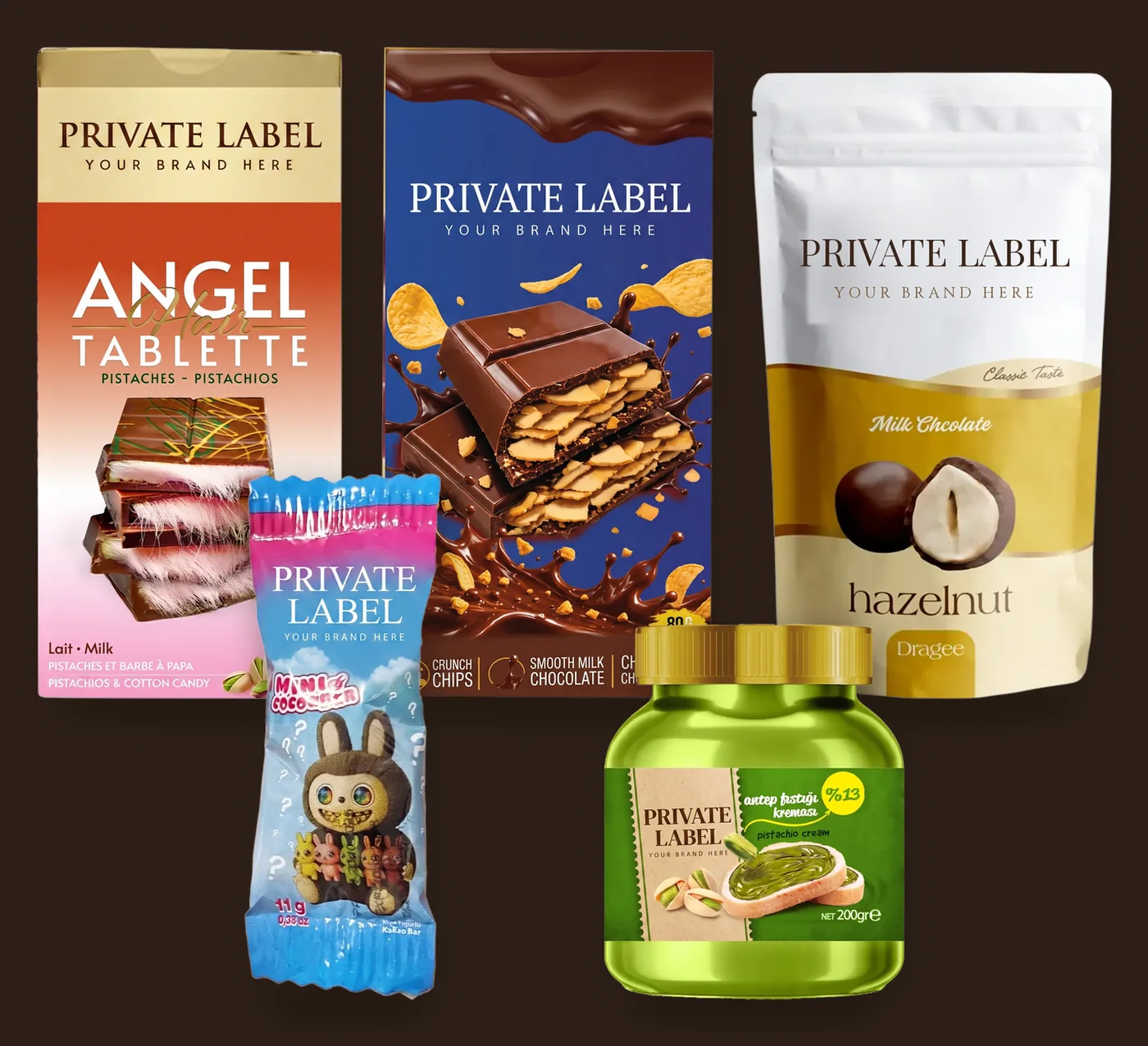
Made in Gaziantep, sold under your brand.
Almost nobody in Bolivia goes looking for a private-label supplier on the internet; the confectionery shelf here is import-fed, and an own-brand line usually starts as a conversation inside a business that already moves containers through Arica or Iquique — a distributor in Santa Cruz that wants its own name on the tablet it has been buying from three suppliers, a wholesaler in El Alto that sells grageas and confites by the carton to the party trade, a supermarket chain building a cheaper shelf, a planner who wants the mesa dulce to carry one brand. So this page is not written to catch a search. It is written to answer the questions that come up once somebody in the office says the words marca propia. Antep Foods is a manufacturer and exporter in Gaziantep, Türkiye: we make the lines in our own factory, put them under your name, and we load one container for the Pacific ports.
The domestic route is worth naming honestly, because Bolivia is a cacao country with makers of its own, and for a plain bar with an origin story a Bolivian chocolatier is the better answer, not us. Where that route runs out is everything that cannot be grown or made here: pistachio tablets and pistachio bars from where the pistachio grows, the pistachio and kadayıf bar the shelf asks for as chocolate de Dubái, sugared almonds and dragées in your own colours, boxed Turkish delight — delicias turcas on the shelf — and pistachio spread in jars. Our argument is breadth in one shipment: five product groups from our own factory under one brand, on one order, one set of documents and one origin proof, instead of five suppliers and five arrivals. Two Bolivian facts then shape the work rather than the price. The box is discharged in Chile and cleared inland, so it passes two customs jurisdictions before it reaches your warehouse; and the country has two shelves at once — the cold, dry altiplano and hot, humid Santa Cruz — which is decided per line before the artwork, not after. The last question is the usual one: who makes it, and at what minimum. We make it in our own factory in Gaziantep; the minimum is set per line and stated in the offer.
Your label goes on lines produced in our own factory in Gaziantep.
Five formats, one container.
Nothing printed before you approve.
- 01
Line and minimum
You name the lines from the product pages and the pack format, and you tell us which shelf they are for — the altiplano, the lowland, or both. We confirm which lines can run under your brand, at what minimum, in what lead time, and whether each one is chocolate or a compound coating for that shelf. Minimums are set per line and stated in the offer.
- 02
Label content
We prepare the Spanish label content from our technical data sheet: the name of the food, the ingredient list with the allergen declaration, the nutrition information, metric net content, storage, the batch and best-before fields we print, and the importer’s name and address. The same data sheet, ingredient breakdown, shelf-life statement and analysis report go to your importer for the SENASAG file, so the wording is fixed here rather than after a wrapper has been printed.
- 03
Artwork approval
Your designer places the content in the arte final; we check it against the label content line by line, and you approve the final version in writing. Nothing is printed before that written approval — not a wrapper, not a box, not a jar label.
- 04
Production and loading
We run the line in our factory, we check and photograph the pallets, each line on its own pallet, and the container leaves Mersin for Arica or Iquique, in a reefer for the chocolate and chocolate-coated lines on the sea leg, with the origin document and the document set your forwarder needs to open the transit inland. The second payment is due against those loading photographs, before the doors close.
What to know before the first list.
- Label
- A Spanish label for the Bolivian market: the name of the product, the ingredient list with the allergen declaration, the nutrition information, metric net content, the batch, the best-before date, storage instructions and the importer's name and address. For lines in our standard packs we confirm what the export pack already carries and what the importer has to add; for private label we prepare the label content from our technical data sheet and check your artwork against it before anything is printed.
- Registration and entry
- Imported food is registered on the importer's side with the national food-safety authority, SENASAG, and the consignment is presented with its documents when it is cleared. From our side you receive the technical data sheet per product, the analysis report per line and our certificates. What each line needs is stated in the offer on the day it is written; none of it is printed on this site, because it changes.
- Customs and the transit through Chile
- Bolivia has no coastline, so a container for Santa Cruz or La Paz is discharged in Chile and travels on under customs transit to the Bolivian inland customs office, where it is cleared. Two jurisdictions touch the same box and the transit paperwork sits with your forwarder. The offer states the tariff line for each product and the duty that applies on the day, so the landed cost is known before you order.
- Certificates
- Our certificates — food-safety scheme, halal, kosher, analysis per lot — are listed in the offer with copies on request. Where a line does not have one, the offer says so.
- Minimums
- Set per line and stated in the offer. The unit of sale is one full container, mixed: your own-brand lines travel beside lines in our standard packs, each line on its own pallet, so a private-label line does not have to fill the box on its own and a first order is not limited to one product.
- Lead time
- Stated per line in the offer and counted from the deposit and the approved artwork, not from the enquiry. On this route two things are added on top of it: the sea leg to the Pacific coast, and the inland transit and clearance after it. The sweet weeks here fall in November and December, at the end of a southern spring, so a pack meant for that table is planned backwards from the date you want the cartons in the warehouse in Santa Cruz or El Alto, not forwards from the order.
- Certificates
- Held for our factory in Gaziantep: food-safety (FSSC 22000, ISO 22000, HACCP), Halal and Kosher certificates. The holder and the certifying body are named per line, copies are available on request, and the analysis report is issued for the line you are quoting. We print no certificate numbers on this site and claim nothing our factory does not hold; where a line is not certified, we say so.
- Currency and payment
- Offers in US dollars. Bank transfer only: 50% with the order, 50% before the container leaves, against the loading photographs of your pallets. The offer states the banking route that applies on the day. If the transfer on your side needs arranging ahead — many importers here plan the dollars before they plan the order — say so at the offer stage, because production starts when the first transfer has arrived and that waiting time belongs in your delivery date.
- The SENASAG file, and whose name is on it
- Imported food is registered on the importer’s side with SENASAG, the national food-safety authority, and the consignment is presented with its documents when it is cleared. On an own-brand line this raises a question that has nothing to do with us and everything to do with you: the brand is yours, but the registration sits with the party that imports it. Settle in writing with your importer, before the first order, whose name the file is opened in and what happens to it if you change distributor later. From our side you get the technical data sheet per line, the ingredient and allergen breakdown, the shelf-life statement, the analysis report and our certificates, and the offer states what each line needs on the day it is written.
- Two customs jurisdictions, two climates
- Bolivia has no coastline. Your container is discharged at Arica or Iquique and travels on under customs transit to the Bolivian inland customs office, where it is cleared — two jurisdictions touch the same box, and the transit paperwork sits with your forwarder. The offer states the tariff line and the duty that applies on the day, along with the port of discharge, the transshipment and the delivery term, FCA Gaziantep, FOB Mersin, CIF or DAP. What happens after the port is the reason the coating is chosen per line: the sea leg can be quoted in a reefer, but the road inland cannot, and it ends either on the cold, dry altiplano or in Santa Cruz, which is hot and humid for most of the year. A brand selling to both is usually two specifications, not one.
- The other route, and what is outside our own range
- A Bolivian chocolatier working with local cacao, or a co-packer over the border, is the shorter road for a plain bar or a bag of wrapped sweets, and we would not argue with it. This route earns its place on what has to come from origin, and on how many product groups one order can carry. Outside our own range: turrón of the nougat kind, which this market buys from Peru and Argentina; cobertura de chocolate, coating chocolate by the kilo for the pastelería trade; raw nuts, dried fruit, cocoa and empty packaging. All of it is sourced on request; we confirm composition and format before quoting, and if it clears it loads in the same container as your own-brand lines.
Asked by brands first.
Are you the manufacturer?
Yes. Chocolate, dragées, pistachio and hazelnut creams, popping candy and Turkish delight are made in our own factory in Gaziantep, and we have exported since 2002. We run your private-label lines, check the lot before packing and load the container at our factory.
Bolivia has no port. How does our own-brand container actually arrive?
It is discharged at Arica or Iquique and moves inland under customs transit to the Bolivian inland customs office for Santa Cruz, La Paz or Cochabamba, where it is cleared. The offer names the port of discharge, the transshipment, the delivery term and the transit; the transit paperwork itself sits with your forwarder, and the offer states the tariff line and the duty that applies on the day.
Who prepares the Spanish label, and how does it reach the SENASAG file?
We prepare the label content from our technical data sheet; your designer places it in the arte final with the importer’s name and address, and you approve the final version in writing. The same data sheet, ingredient breakdown, shelf-life statement and analysis report go to your importer for the registration file, so the printed pack and the file agree from the start. Nothing is printed before your written approval.
Should our line be chocolate or compound?
It depends on which shelf you are selling to, and the offer states line by line which one you are buying. The sea leg can be quoted in a reefer, but the road from Arica inland is on the importer’s side, and a line that ends in hot, humid Santa Cruz is a different specification from one that ends on the cold altiplano. A vegetable-fat coating is never called chocolate on the pack, in the label content or in our paperwork.
Can a first order be a single product?
The unit of sale is one full container, but it is mixed: your own-brand line travels in the same container as lines in our standard packs, each on its own pallet. So a first order can be one own-name tablet or one lokum box plus a working assortment, rather than one product in bulk.
Can you make turrón or cobertura de chocolate under our brand?
Both sit outside our own range: sourced on request; we confirm composition and format before quoting. Turrón of the nougat kind reaches this shelf from Peru and Argentina, and the Turkish lines that take that position are boxed Turkish delight, sugared almonds and pistachio pieces. What we do run under your name is the tablet, the bar, the dragée, the lokum box, the sachet and the pistachio spread jar.
Can we put the Dubai-style bar under our own name?
Yes, on our own lines, in retail and gift formats. The pistachio and the kadayıf are made in Gaziantep where we load, and the bar can travel in the same container as pistachio tablets, dragées and pistachio spread jars under the same brand. The minimum per line and the lead time are stated in the offer, and the coating is stated as chocolate or compound before the artwork is drawn.
Are you a private label chocolate manufacturer?
Yes. Your label is printed in our own factory in Gaziantep after you approve the artwork, and the minimum per line is stated in the offer. Prices are not published; they come in the written offer.
Importing into Bolivia: what stays the same on every offer →
Send the list. We do the rest.
Send your product list with approximate quantities and the destination port. You get one offer covering every line, then one container, loaded and photographed before the doors close.
 Mixed containerHow a list becomes a container →