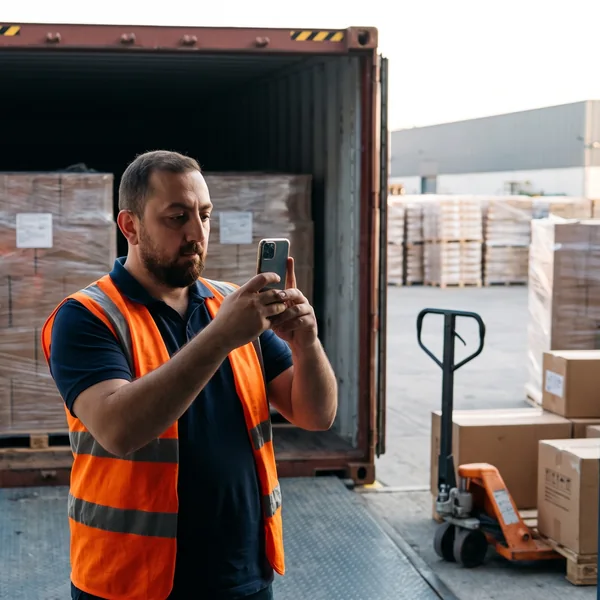
The short leg is the one inside Türkiye
The producers are in Gaziantep, Mersin port is about three hours away by road, and consolidation and loading sit inside that window: several lines meet in one box, under one documentset.
After that it is water. Because there is a coastline here, the box is discharged in your own country rather than crossing a land border under transit — the leg hardest to price inland. What stays is the run after clearance: if you unload upcountry, name that place in the enquiry.
Two chains, two different boxes
A bean travels as a crop: in bulk, at ambient temperature, on paperwork built around a harvest. A wrapped tablet or a boxed Turkish delight travels as an industrial product, on printed packaging, with a technical data sheet behind it.
That decides how the container is booked: chocolate and chocolate-coated lines in a reefer through the warm months, Turkish delight, dragées and jellies dry; the two still share one box.
The source table is also a route map
These are mirror figures: the market does not report its own imports, so each column is what others recorded as shipments in — a direction, not a settled number. On 2024 data the chocolate arriving is worth about 8,308,756 US dollars, Türkiye first at roughly 33.81 per cent and Senegal second at 23.7; sugar confectionery is larger at about 14,090,887 dollars and fed from much further off, China 47.9 per cent, Türkiye seventh at 1.83.
The second name in the chocolate column is a neighbour on the same coast that neither grows cocoa nor moulds tablets — redistribution: landed at a larger port, warehoused, sold on. Each stop is a margin, a risk and a week.
Four terms, and the gap between two of them
FCA Gaziantep ends at our loading bay. FOB Mersin buys the road leg and ends on board. CIF carries the sea leg to a discharge port the offer names. DAP alone keeps going after clearance, to a place you name.
Ask for one list priced on two of them. The difference is not a discount; it is a leg of the journey, priced now rather than invoiced later. The offer names the term, the port it is quoted against and where our responsibility ends.
Who declares, and what travels with the box
The customs file is national: the importer holding the registration files the consignment and answers for the description given. The origin document and the rules that apply are named in the offer, which states what applies on the day.
From our side comes what that desk has to accept: the technical data sheet per product, our certificates and the analysis report per line,with. Certificates are issued for our factory rather thanours, with the certifying body named; gelatine lines carry our halal certificate.
The panel in French, and what to send next
The mandatory information is prepared in French — name of the food, ingredients with allergens, metric net weight, storage conditions, the importer’s name and address, the date marking — with English alongside if wanted. Own-label artwork is checked before anything is printed, and a vegetable-fat coating is a compound or a glaze wherever it appears: in the European Union it cannot be labelled chocolate at all. The jar line is a spread.
Send the lines you want quoted with the format for each, an indicative quantity, the discharge port, the place you unload at and whose brand the pack carries, then ask for the list on two terms. One container takes several linesunder one document set (mixed container). Couverture, bulk chocolate by the kilo, raw nuts, dried fruit, cocoa, baklava, halva and tahini are sourced on request, composition and format confirmed before quoting (how wework).
Cocoa grows here. Does that change how we buy finished chocolate?
Only in the sense that it makes two chains easy to confuse. A bean is a crop moving outward in bulk; a wrapped tablet is an industrial product moving inward on printed packaging, a technical data sheet and a named manufacturer. Growing the first does not shorten the route of the second. What can be shortened is the number of stops between the producer and your warehouse.
Part of the chocolate here arrives by way of a neighbouring country. Why load at origin instead?
On the mirror figures the second source in that column is a neighbour on the same coast, at roughly 23.7 per cent, which usually means cartons landed at a larger port, warehoused and sold on. Loading a full container at the point of consolidation does not necessarily buy a different product; it buys fewer steps, one document set, and an arrival date you set rather than inherit.
Which term reaches our warehouse, and who files the entry?
DAP is the one of the four that names a delivery place beyond the port, so the run after clearance is priced rather than left open; CIF stops at the discharge port with that run still ahead of you. The importer holding the registration files the entry and answers for the description given, and your clearing agent works it on the ground. The origin document and the applicable rules are named in the offer in the form valid on the day.