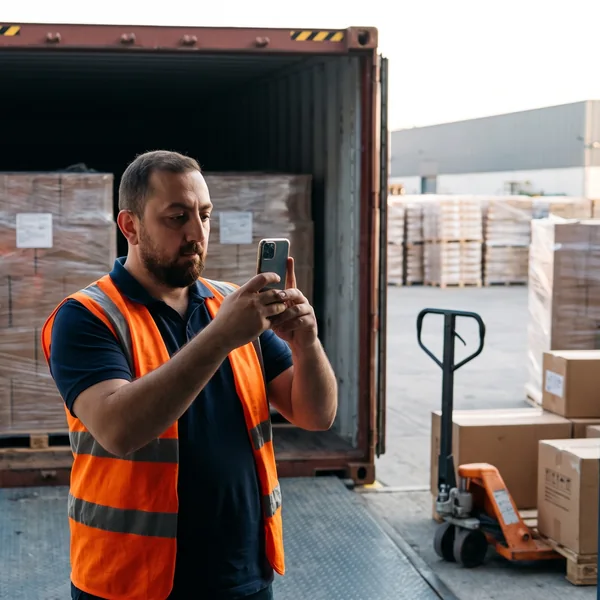
The stretch no freight rate covers
The order is fixed. Lines from our own factory are consolidated in Gaziantep, the box loads atMersin — about three hours away by road — crosses to a port in the region, and continues inland by truck (mixed container).
The sea crossing is a published figure. The overland run is not: it moves with the corridor, the season and whoever booked the truck. An offer that stops at the quay has answered the cheap half.
Four terms, one real question
Read the terms as one question — where do we stop arranging carriage and you begin? FCA Gaziantep hands the goods over loaded at origin. FOB Mersin takes them to the ship. CIF covers the sea leg and ends at a coastal port outside your country, the road still ahead of you.
DAP is the only one of the four naming an inland destination, so it is the only one under which the overland leg reaches you as a price rather than a later invoice. If your own forwarder runs that corridor, the earlier terms cost less.
The warm hours are the road hours
A pallet spends its coolest hours at sea and its warmest afterwards — in a yard, waiting on a transit, driven inland in a box that has been in the sun since morning. Chocolate is judged on that stretch, not the one before it.
So the quotation says which lines travel how. Through the warm months anything chocolate or chocolate-coated is priced in a reefer, while dragées, Turkish delight, jellies and wrapped confectionery are priced dry. Both sets ride in one container, and the list marks which basis each line took.
Two declarations, neither of them ours
After discharge the consignment moves inland under a transit procedure filed by your clearing agent, then is declared at the inland office by the importer who holds the registration and answers for the description. No supplier abroad can hold either position.
What we can do is give both desks nothing to argue with: on the packing list, marks, case count, net and gross weight and the seal number match the box, because a figure that disagrees with the carton turns a transit into a wait.
What travels with each line, and in which language
Per line you receive the technical data sheet, our certificates and the analysisreport. Certificates are issued for our factory, never ours; where aline carries ingredients of animal origin, gelatine above all, the halal certificate is ours and its certifying body is named. The origin document and the rules that apply are stated in the offer as they stand on the day.
Mandatory label content is prepared in English, with French alongside where your file or your shelf asks for it: the food name, metric net weight, the ingredient list with allergens, storage conditions, the date marking and the importer’s name and address. A vegetable-fat coating is a compound or a glaze, never chocolate — in the European Union it cannot be labelled chocolate at all — and the jar line is a spread.
What to send so the route can be priced
A quotable enquiry is short: the references, the format behind each one — bulk carton, retail box, doypack or jar — a rough quantity, the port you clear through, the inland address the truck is going to, and whose name the pack carries. Own-label artwork is printed only after your written approval.
Ask for the same list priced twice, on CIF and on DAP: the gap between them is the overland run in figures. Anything beyond the range — baklava, halva, tahini, cocoa, dried fruit, raw nuts, empty packaging, couverture and bulk chocolate sold by the kilo — is sourced on request, and we confirm composition and format before quoting (how wework).
We are inland. Which delivery term actually reaches our warehouse?
DAP is the one that names an inland destination, so the road leg is priced instead of left open. CIF ends at a coastal port in another country with the overland run still ahead of you, while FCA Gaziantep and FOB Mersin hand over earlier and suit a buyer whose own forwarder controls the corridor. Ask for the same list on two terms and read the difference.
The container is discharged in a neighbouring country. Who files what?
Your clearing agent files the transit movement from the port of discharge to the inland customs office, and the importer who holds the registration declares the consignment and answers for the description. From our side come the technical data sheet per product, our certificates, the analysis report perline and, with the origin document stated in the offer in the form valid onthe day.
Why does the sweet shelf here arrive from coastal neighbours?
Because dry confectionery survives a long road leg that chocolate does not, and a coastal origin can supply it without a temperature-controlled box. On 2024 mirror figures the sugar confectionery column is filled almost entirely from two origins, Kenya at roughly 64.1 per cent and India at 31.1, while Türkiye stands third in the chocolate column at 13.03. Those figures are borrowed from other countries’ export records, so read them as a direction rather than a settled total.